OAuth2 Proxy Sidecar: Decentralized Authentication as a Paved Path
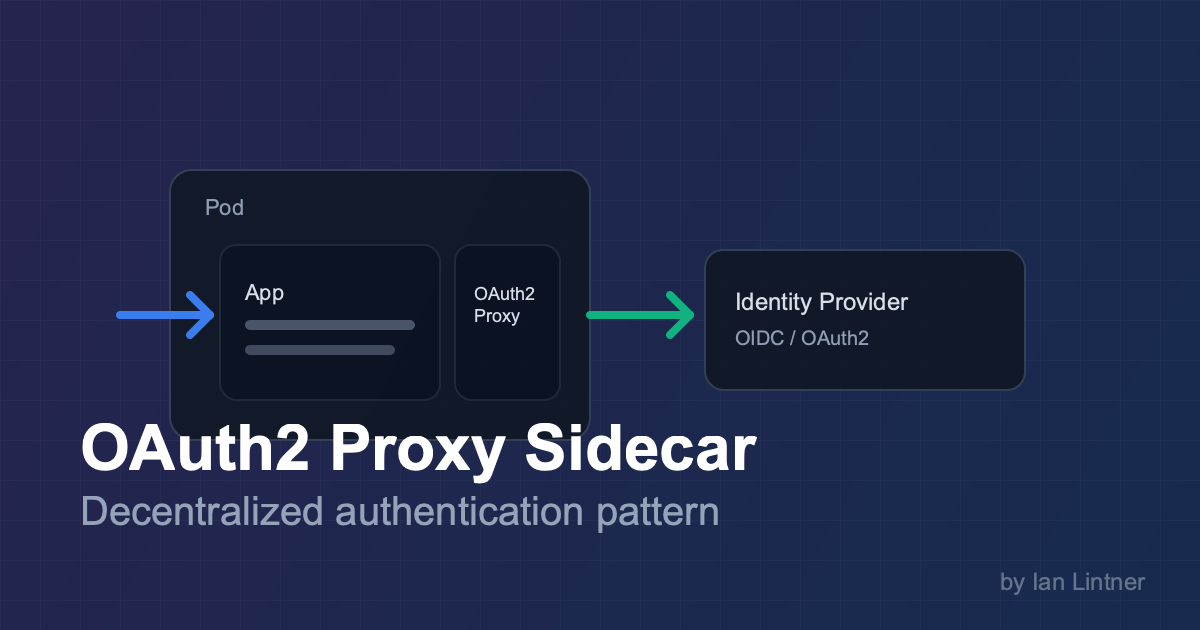
Remember that centralized vs. distributed K8s manifest management discussion we had? Well, let me tell you about authentication—because if you thought manifest management was spicy, just wait until you see what teams do with auth.
I've seen some wild approaches:
- A centralized auth service that became a single point of failure and a bottleneck (double whammy).
- Teams reimplementing OAuth2 in every. Single. Service. (What could go wrong?)
- Complex Istio
ext_authzconfigurations that nobody understood after the person who wrote them left.
Then I found the OAuth2 Proxy sidecar pattern, and it was like finding a $20 bill in your winter coat. It just works.
🎯 TL;DR for the Busy Folks

| Factor | Centralized Auth Service | OAuth2 Proxy Sidecar |
|---|---|---|
| Complexity | Istio ext_authz filters, EnvoyConfig | Simple container in pod |
| Single Point of Failure | ❌ Yes | ✅ No—scales with app |
| Debugging | Distributed logs, hard to trace | Logs in same pod as app |
| Per-App Customization | Limited | ✅ Each app configures independently |
| Developer Experience | "Wait for platform team" | "Add sidecar, deploy" |
| Resource Overhead | Low (single deployment) | ~50-100MB per app |
| Migration Risk | High (all apps at once) | Low (one app at a time) |
The punchline: Sidecar pattern is the "paved path"—standardized but decentralized. Teams get autonomy without chaos.
🏗️ What Is the Sidecar Pattern?
The sidecar pattern is like riding a motorcycle with a buddy in the sidecar. Your app is the driver, and the OAuth2 proxy is your buddy handling all the "are we there yet?" questions from users trying to authenticate.
Key characteristics:
- Co-located: Lives in the same pod as your app
- Localhost communication: App talks to sidecar on
127.0.0.1 - Isolated: Each app has its own auth instance
- Transparent: App just reads headers, doesn't implement OAuth2
🔄 The Flow: How It Actually Works
Let's walk through what happens when someone tries to access your app:
The magic:
- Cookie-based sessions means no database lookup on every request
- Localhost proxy adds ~1-5ms latency (negligible)
- Zero code changes in your app—just read the headers
💡 Why This Is a "Paved Path"
A paved path in platform engineering is a pattern that:
- ✅ Standardized - Everyone uses the same approach
- ✅ Self-service - Teams can adopt it without platform team help
- ✅ Opinionated - Makes the right thing easy, wrong thing hard
- ✅ Flexible - Allows customization where it matters
The OAuth2 proxy sidecar hits all four:
1. Standardized Configuration
Platform team provides a Helm chart or Kustomize base:
# Base ConfigMap - shared by all apps
apiVersion: v1
kind: ConfigMap
metadata:
  name: oauth2-proxy-config
data:
  oauth2_proxy.cfg: |
    provider = "github"
    cookie_domains = [".example.com"]
    cookie_secure = true
    cookie_httponly = true
    pass_user_headers = true
    set_xauthrequest = true
2. Self-Service Adoption
Product teams just add the sidecar to their deployment:
apiVersion: apps/v1
kind: Deployment
metadata:
  name: my-awesome-app
spec:
  template:
    spec:
      containers:
        # Your app - no changes needed
        - name: app
          image: my-app:latest
          ports:
            - containerPort: 8080

        # OAuth2 Proxy sidecar
        - name: oauth2-proxy
          image: quay.io/oauth2-proxy/oauth2-proxy:v7.6.0
          args:
            - --config=/etc/oauth2-proxy/oauth2_proxy.cfg
          env:
            - name: OAUTH2_PROXY_REDIRECT_URL
              value: "https://my-app.example.com/oauth2/callback"
            - name: OAUTH2_PROXY_UPSTREAMS
              value: "http://127.0.0.1:8080"
          ports:
            - containerPort: 4180
          volumeMounts:
            - name: config
              mountPath: /etc/oauth2-proxy
      volumes:
        - name: config
          configMap:
            name: oauth2-proxy-config
That's it. No Slack message to the platform team. No ticket. No waiting.
3. Opinionated Defaults
The platform team encodes security best practices:
- ✅ Cookie encryption enforced
- ✅ Secure & HTTPOnly cookies by default
- ✅ User headers injected automatically
- ✅ Email domain restrictions (if needed)
# Example: Restrict to company domains
email_domains = ["example.com", "contractor.com"]
4. Flexibility Where It Matters
Teams can customize per-app:
- Different OAuth providers (GitHub for external, Azure AD for internal)
- Email restrictions (limit to specific teams/orgs)
- Custom templates (branded sign-in pages)
- Session duration (shorter for sensitive apps)
env:
  # Override: Use Google for this app instead of GitHub
  - name: OAUTH2_PROXY_PROVIDER
    value: "google"
  - name: OAUTH2_PROXY_EMAIL_DOMAINS
    value: "example.com"
  # Custom session duration
  - name: OAUTH2_PROXY_COOKIE_EXPIRE
    value: "4h" # Shorter for sensitive apps
🆚 Comparison: Sidecar vs. Alternatives
Pattern 1: Centralized Auth Service (ext_authz)
This is the "one ring to rule them all" approach:
Pros:
- ✅ Single deployment = lower resource usage
- ✅ Centralized management
Cons:
- ❌ Single point of failure (if auth is down, everything is down)
- ❌ Complex Istio configuration (EnvoyFilter + ext_authz)
- ❌ Hard to debug (auth logs separate from app logs)
- ❌ Platform team bottleneck (all changes go through them)
- ❌ Difficult migration (all or nothing)
I've been paged at 2 AM because the centralized auth service crashed. Never again.
Pattern 2: Per-App OAuth Implementation
This is the "everyone for themselves" approach:
Pros:
- ✅ Maximum flexibility
- ✅ No shared infrastructure
Cons:
- ❌ Every team reimplements OAuth2 (reinventing the wheel)
- ❌ Language-specific libraries (Java, Python, Node, Go—all different)
- ❌ Security vulnerabilities vary by implementation
- ❌ Token refresh logic duplicated everywhere
- ❌ Hard to enforce standards (good luck with that security audit)
This is how you end up with nine different OAuth implementations, three of which have vulnerabilities.
Pattern 3: OAuth2 Proxy Sidecar (The Sweet Spot)
Pros:
- ✅ No single point of failure (scales with app)
- ✅ Simple configuration (just add container)
- ✅ Easy to debug (logs in same pod)
- ✅ Per-app customization (different OAuth providers, policies)
- ✅ Language-agnostic (works with any app)
- ✅ Gradual migration (adopt one app at a time)
- ✅ Self-service (teams don't need platform approval)
Cons:
- ⚠️ Slightly higher resource usage (~50MB per app)
- ⚠️ More pods to manage (but Kubernetes is good at this)
🛠️ Real-World Example: The authproxy Project
I built authproxy to demonstrate this pattern in production. It includes:
1. Helm Chart for Easy Adoption
helm repo add oauth2-sidecar https://ianlintner.github.io/authproxy
helm install oauth2-sidecar oauth2-sidecar/oauth2-sidecar \
  --set oauth.provider=github \
  --set oauth.clientID=YOUR_GITHUB_CLIENT_ID \
  --set domain=example.com
2. Pre-Built ConfigMaps and Secrets
# Platform team creates once
apiVersion: v1
kind: Secret
metadata:
  name: oauth2-proxy-secret
type: Opaque
data:
  client-id: <base64-encoded>
  client-secret: <base64-encoded>
  cookie-secret: <base64-encoded>
3. Example App Deployment
The k8s/apps/example-app/ directory shows a complete working example:
- Deployment with sidecar
- Service exposing port 4180
- VirtualService routing traffic
- Complete documentation
4. Helper Scripts
# Add auth to existing app in one command
./scripts/add-sidecar.sh my-app default 8080 my-app.example.com
This script:
- Patches the deployment with the sidecar container
- Updates the Service to route to port 4180
- Creates/updates the VirtualService
- Validates the configuration
Result: Authentication in ~30 seconds, no manual YAML editing.
📊 Decision Matrix: When to Use Sidecar Pattern
Here's when the sidecar pattern makes sense:
| Scenario | Use Sidecar? | Why |
|---|---|---|
| 10-200 microservices | ✅ Yes | Sweet spot for standardization + autonomy |
| Multiple teams/products | ✅ Yes | Self-service = less platform bottleneck |
| Different OAuth providers needed | ✅ Yes | Each app can use different provider |
| High security requirements | ✅ Yes | Isolated credentials per app |
| Single monolith | ❌ No | Centralized auth is simpler |
| Very cost-sensitive (<20MB matters) | ⚠️ Maybe | Consider centralized if budget is tight |
| <5 services | ⚠️ Maybe | Centralized is fine for small scale |
My rule of thumb:
- <10 services: Centralized is fine
- 10-200 services: Sidecar pattern is the sweet spot
- >200 services: You probably have a platform team building a service mesh anyway
🎯 Real-World Patterns I've Seen Work
Pattern 1: "Golden Path" with Escape Hatches
Platform team provides:
- Standard Helm chart with secure defaults
- Pre-configured GitHub/Azure AD OAuth
- Custom branded sign-in page templates
- Documentation and examples
Product teams can:
- Use the Helm chart as-is (80% case)
- Override specific settings (15% case)
- Roll their own if needed (5% case—but discouraged)
Pattern 2: Progressive Rollout
Migration strategy:
- Week 1: Deploy sidecar to dev environment
- Week 2: Deploy to staging, validate SSO works
- Week 3: Deploy to one prod app (low risk)
- Weeks 4-8: Roll out to remaining apps, one per week
Rollback plan:
- Sidecar and centralized auth can coexist temporarily
- Remove sidecar = instant rollback to centralized
- Low risk, high confidence
Pattern 3: Per-Environment Customization
# dev: Permissive, fast iteration
dev:
  oauth:
    provider: github
    allowedEmails: ["*@example.com"]
  session:
    cookieExpire: 24h

# staging: Closer to prod
staging:
  oauth:
    provider: azure
    allowedGroups: ["engineering"]
  session:
    cookieExpire: 8h

# prod: Strict, audited
prod:
  oauth:
    provider: azure
    allowedGroups: ["engineering", "sre"]
    requireMFA: true
  session:
    cookieExpire: 4h
🐛 Common Pitfalls (And How to Avoid Them)
Pitfall 1: Redirect Loop Hell
Symptom: Browser keeps redirecting between app and OAuth provider.
Cause: OAUTH2_PROXY_REDIRECT_URL doesn't match your domain.
Fix:
env:
  - name: OAUTH2_PROXY_REDIRECT_URL
    # MUST match your actual domain
    value: "https://my-app.example.com/oauth2/callback"
Pro tip: Use $(HOSTNAME) in Helm for dynamic hostnames.
Pitfall 2: Service Routes to Wrong Port
Symptom: 404 or connection refused errors.
Cause: Service routes to app port (8080) instead of sidecar (4180).
Fix:
apiVersion: v1
kind: Service
metadata:
  name: my-app
spec:
  selector:
    app: my-app
  ports:
    - name: http
      port: 4180 # ← Route to sidecar, not app
      targetPort: 4180 # ← Matches sidecar port
Pitfall 3: Cookie Domain Mismatch (No SSO)
Symptom: Have to log in separately for each app.
Cause: Cookie domain not set to .example.com (note the leading dot).
Fix:
# ConfigMap
cookie_domains = [".example.com"]  # Leading dot = wildcard
Result: Single sign-on across all *.example.com apps. Beautiful.
🔐 Security Considerations
1. Cookie Encryption
The cookie_secret must be cryptographically secure:
# Generate a secure secret
python -c 'import os,base64; print(base64.urlsafe_b64encode(os.urandom(32)).decode())'
Store in Kubernetes Secret, never commit to Git.
2. OAuth Credentials Management
Best practice: Use Azure Key Vault, AWS Secrets Manager, or HashiCorp Vault with CSI driver:
apiVersion: v1
kind: Pod
spec:
  volumes:
    - name: secrets-store
      csi:
        driver: secrets-store.csi.k8s.io
        volumeAttributes:
          secretProviderClass: "azure-keyvault-oauth"
3. Email Domain Restrictions
Limit access to your organization:
email_domains = ["example.com"]
Or use GitHub org/team restrictions:
github_org = "my-company"
github_team = "engineering,sre"
4. Session Duration
Shorter is more secure, but balance with UX:
cookie_expire = "4h"   # Session lifetime
cookie_refresh = "1h"  # Refresh interval
For highly sensitive apps (admin panels, billing):
cookie_expire = "30m" # Force re-auth every 30 min
📈 Observability and Monitoring
1. Prometheus Metrics
The oauth2-proxy exposes metrics on /metrics:
apiVersion: v1
kind: ServiceMonitor
metadata:
  name: oauth2-proxy-metrics
spec:
  selector:
    matchLabels:
      app: oauth2-proxy
  endpoints:
    - port: http
      path: /metrics
Key metrics to alert on:
oauth2_proxy_requests_total{status="401"}— Authentication failuresoauth2_proxy_upstream_latency_seconds— Latency to your appoauth2_proxy_errors_total— OAuth provider errors
2. Structured Logging
Configure JSON logging for easy parsing:
# ConfigMap
standard_logging = false  # Disable Apache-style logs
auth_logging = true
request_logging = true
Example log entry:
{
  "level": "info",
  "timestamp": "2025-12-01T10:30:00Z",
  "message": "authenticated",
  "email": "user@example.com",
  "path": "/dashboard",
  "upstream": "http://127.0.0.1:8080"
}
3. Distributed Tracing
If using Jaeger or Zipkin, oauth2-proxy propagates trace IDs:
pass_authorization_header = true
pass_user_headers = true
🚀 Migration Strategy: From Centralized to Sidecar
If you're currently using centralized auth, here's how to migrate safely:
Phase 1: Dual-Run (Week 1-2)
- Deploy sidecar to one non-critical app
- Run both centralized auth and sidecar
- Monitor for issues (redirect loops, cookie problems)
Phase 2: Gradual Migration (Week 3-8)
- Migrate one app per week
- Prioritize low-traffic apps first
- Keep centralized auth running for unmigrated apps
Phase 3: Deprecation (Week 9-10)
- Once all apps migrated, announce deprecation
- Remove centralized auth deployment
- Delete ext_authz EnvoyFilter configs
Rollback plan:
- Keep centralized auth deployment for 2 weeks after last app migration
- If issues, just delete sidecar from deployment
🎓 Lessons from the Field
Lesson 1: Don't Over-Engineer
I've seen teams try to build "the perfect auth system" with:
- Multiple OAuth providers per app
- Complex RBAC integrated with auth
- Custom UI for every single app
Reality check: Start simple. GitHub OAuth + email domain restriction covers 90% of use cases.
Lesson 2: Documentation > Perfection
The best auth system is the one teams actually use.
Write docs like this:
# Adding Auth to Your App

1. Copy this YAML
2. Change `my-app` to your app name
3. Deploy
4. Done

Questions? Slack us in #platform-help
Not like this:
# OAuth2 Proxy Architecture

This document describes the theoretical foundations of OAuth2
authentication using the sidecar pattern in distributed systems...
(Save the architecture deep-dive for a separate doc.)
Lesson 3: Make the Right Thing Easy
Bad: "Read these 10 pages of docs, then open a Jira ticket for OAuth credentials."
Good: "Run this script: ./add-auth.sh my-app"
Self-service wins every time.
🎯 Conclusion: Why This Matters
The OAuth2 proxy sidecar pattern represents a fundamental shift in how we think about platform capabilities:
Old way (Centralized):
- Platform team owns everything
- Product teams file tickets
- Changes are slow and risky
New way (Paved Path):
- Platform team provides the path
- Product teams walk it themselves
- Changes are fast and safe
The result:
- ✅ Faster time-to-production (no waiting for platform team)
- ✅ Better security (standardized, auditable)
- ✅ Happier developers (self-service + autonomy)
- ✅ Less platform toil (fewer tickets, more automation)
This isn't just about authentication. It's about building platforms that scale—not just technically, but organizationally.
The sidecar pattern for auth is proof that decentralization done right beats centralization every time.
📚 Resources
- authproxy GitHub repo — Complete working example with Helm chart, docs, and scripts
- OAuth2 Proxy Documentation — Official docs for oauth2-proxy
- Istio Sidecar Pattern — Understanding the sidecar pattern in Istio
- Platform Engineering Principles — Building paved paths for teams
What's Next?
In my next post, I'll dive into multi-tenancy patterns in Kubernetes and how to build tenant isolation without losing your mind. Because if you thought auth was complex, wait until you try to isolate 50 customers in the same cluster.
Stay tuned. And as always, you betcha. 🎣